Showing posts with label Empire Of Ancient Egyptian - Chapter One. Show all posts

Monday, October 17, 2011

Models and Magic

The tomb of Meketre, chancellor to Eleventh Dynasty king Mentuhotep II, held a secret missed by the looters who otherwise stripped it. In a sealed chamber, Meketre had placed 25 exquisitely detailed models of daily life and activities that his spirit could magically activate to brew his afterlife beer, catch fish for him, clean his house, serve his meals, bake his bread, haul water, care for his animals, fight off invaders, weave linen, build him a Nile yacht—any task that would need doing in the afterlife.

A model of the cattle census is complete with animals, herdsmen, village officials, and royal tax collectors. There are models of granaries (buildings for storing grain), boats of different sizes, and Meketre’s house and garden.

There are miniature workshops for bakers, butchers, brewers, weavers, and woodworkers Meketre added model serving girls to carry water, and battalions of tiny archers and soldiers, ready to fight if the need arose. Some of the models from Meketre’s tomb can be seen at the Metropolitan Museum of Art in New York City (the rest are in the Cairo Museum).

The tradition of placing such models, and other servant figures, such as ushabtis (“answerers”), in tombs was a typical Egyptian response to a practical problem. With fewer resources available to build and stock huge, lavish tombs, even the king relied on magical servant figures, and paintings, figurines, and menus that could be magically activated as needed.
Read more »

The Second Intermediate Period

The horror of having their throne seized by foreigners caused the Egyptians to see the Hyksos in the worst possible light. But in many ways, Hyksos rule was the best thing that could have happened to Egypt. It rescued Egypt from political turmoil and cultural decline. The Hyksos brought fresh ideas and new technologies to a land that had become fixed in its outlook.

They introduced Egypt to superior bronze-age technology, already in wide use elsewhere. They introduced new military strategies, tactics, and equipment: the chariot and horse, the composite bow, scale armor (armor with solid, overlapping tabs of metal, rather like metal fish scales), and im- proved daggers and swords. Without these innovations, it is doubtful Egypt could have become an imperial superpower.

The Hyksos also introduced fresh ideas to the arts and everyday life. The vertical weaving loom, stringed musical instruments (lute and lyre), the oboe, the tambourine, the olive and pomegranate trees—all came to Egypt with the Hyksos. This 107-year period (1630 to 1539 B.C.E.) spans Dynasties 15 to 17.
Read more »

Saturday, September 10, 2011

The Middle Kingdom - Part 2

When Senwosret I took the throne, he continued his military activities, securing Egypt’s southern border at the second cataract with 13 forts. He sent mining expeditions to Nubia, Syria, and the western oases. He built a magnificent solar temple at Heliopolis.

The 34-year reign of his son, Amenemhet II, saw great achievements. The king widened and deepened the canal that fed the Faiyum from the Nile, expanding hunting, fishing, and agriculture. He sent trade expeditions to Punt, the Red Sea, Lebanon, and the Levant. He carried on a thriving trade with the Mediterranean island of Crete.
Read more »

The Middle Kingdom - Part 1

After years of fighting, the family in Thebes prevailed. They reunited Egypt under Mentuhotep II, leader of the last phase of the struggle against the Herakleopolitans. On becoming king, Mentuhotep took the kingly title “He who gives heart to the two lands.” (This kingly title was called a Horusname, after Horus, the falcon-headed god who was the traditional protector of Egyptian kings. The king is the physical embodiment of Horus-on-earth. To the ancient Egyptians, he was Horus.) In his 14th year of rule, he crushed a major rebellion in Abydos, securing his control of Upper Egypt. He changed his Horus-name to “Lord of the white crown.”

It was not until his 39th year of rule that he reunited Upper and Lower Egypt. He changed his Horus-name to “Uniter of the two lands.” So began the Middle Kingdom, which lasted 350 years and encompassed Dynasties 11 (late) to 14 (1980 B.C.E. to 1630 B.C.E.).
Read more »

The First Intermediate Period

The god-king no longer enjoyed exalted status. Local rulers and nomarchs had grabbed much of his authority. When the collapse finally came, it was sudden and complete.

While general disorder and the independence of local rulers helped bring about the collapse of the Old Kingdom, many scholars believe that climate change in Africa and the Near East had at least as much to do with it. Changes in the patterns of monsoon rains over the Abyssinian highlands caused widespread drought and a series of low Niles. Food production abruptly declined. Hot winds blew from the south for weeks at a time, according to some ancient texts. Sandstorms and dust storms hid the sun for days. Already dry farms turned to dust. In some places, the Nile was so shallow that it could be crossed on foot. Drought and famine in the Near East drove bands of starving, desperate refugees to Egypt’s borders, putting additional pressure on food and water supplies.
Read more »

Thursday, September 8, 2011

The Old KingDom - Part 3

But there was rumbling on the borders. Soldiers often had to be sent to Nubia to protect trade routes and to recruit mercenaries (soldiers for hire) for the army and police forces. A major fort was established at Buhen, near the second cataract. Libyan raiders made repeated incursions from the western desert.

The Fifth Dynasty ended in confusion. The first king of the Sixth Dynasty, Teti, settled things down. But the power and influence of the king was severely declining. Local nobles no longer felt it necessary oreven desirable to be buried near the king. They built tombs for themselves and their families in their own districts.
Read more »

Connections - The Square Sail

Travel south to north in Egypt was always easy because that is the direction in which the Nile River flows. But north to south travel was slow and cumbersome until a clever boatman had a brainstorm around 3350 B.C.E. He attached a large square of fabric (probably linen) to a yard (a horizontal pole) that was attached to a mast near the front of his Nile boat. This sail caught the prevailing north-to-south winds and propelled his boat upriver.

Square sails are very inefficient if conditions require much steering and tacking (sailing on a zigzag into the wind). But since the Nile is relatively straight, calm, and easy to navigate, Egyptian sailors saw no need to improve much upon this invention. The little steering that was required needed only a steering pole or the use of slender steering oars. The square sail served them well for thousands of years.
Read more »

The Old KingDom - Part 2

The Pyramid’s interior is a complex maze of chambers, tunnels,shafts, and corridors. There is much controversy about the purpose and nature of some of these features, and whether there might be still-undiscovered features inside, or beneath, the Great Pyramid.

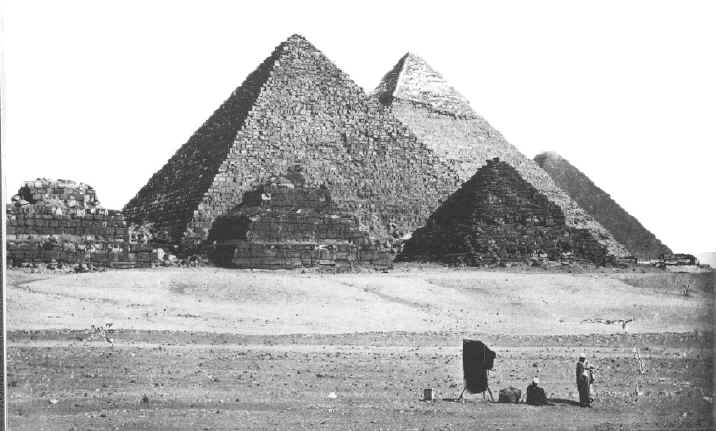
Khufu’s son, Khafre, built his slightly smaller pyramid complex near his father’s. He added a unique touch: the Great Sphinx. A reclining lion with a human head and Khafre’s face, this guardian of the necropolis, carved from a natural outcrop of limestone, is 60 feet tall and 240 feet long. King Menkaure’s pyramid, the third at Giza, is only half the height of the Great Pyramid. In fact, the huge pyramids of Sneferu, Khufu, and Khafre were a departure from the normal scale of the vast majority of pyramids. Many scholars think that after Khafre the emphasis turned to temples and their decoration.
Read more »

The Old KingDom - Part 1

The Old Kingdom spans Dynasties 4 through 8, a period of 495 years from 2625 B.C.E. to 2130 B.C.E. It was the age of the great pyramids. The rule of the god-king was absolute. He alone was privileged to enjoy eternal life. As chief priest, he controlled the Nile and the inundation, and made sure the sun rose every day. As leader of an increasingly prosperous country, he commanded enormous power and wealth. Old Kingdom kings poured all of Egypt’s resources into ensuring that their afterlives would be as luxurious and glorious as possible.

For a few hundred years at the height of the Old Kingdom, all Egypt’s wealth—stone, gold, and gems, every peasant’s labor, every artisan’s skill, the central government, and the entire religious establishment—were harnessed for a single goal: building royal tombs. Advances in architecture,
astronomy, surveying, construction, quarrying, stonework, sculpture, art, and hieroglyphic writing were focused on designing, building, decorating, and maintaining the king’s tomb and vast necropolis—a city of the dead, where tombs were laid out like a well-planned town.
Read more »

Tuesday, September 6, 2011

The Early Dynastic Period

king Narmer
Narmer’s triumph did not put an immediate end to conflict. There were many periods of localized warfare. Forces from the north and south clashed. For awhile, the two lands continued to think of themselves as separate kingdoms.

Narmer, who was from Ta-Shomu, may have married a Ta-Mehu princess to establish his right to rule the north. Throughout Egyptian history, many kings chose wives to strengthen their ties to the royal family or to cement a political or diplomatic relationship. Second Dynasty king Khasekhemwy also married a northern princess.

This period, known as the Early Dynastic Period, covers 375 years of what Egyptologists have named Dynasties 0 to 3 (3000 B.C.E.–2625 B.C.E.). Most information about the Early Dynastic Period comes from royal tombs at Abydos, and tombs of nobles at Saqqara. The few items missed by tomb robbers show that arts and crafts were already highly advanced.
Read more »

Egypt Before The Empire

The Pyramids
IN EARLY PREHISTORIC TIMES, THE NILE VALLEY WAS NOT Agreat place to live. Each summer, floodwaters filled the narrow gorge cliff to cliff. When they receded, the valley remained wet and marshy.

But it was a hunter’s paradise. The Nile was alive with fish. Papyrusthickets teemed with game birds. Antelopes, gazelles, oryxes, andwild bulls grazed in lush greenery near the cliffs. Crocodiles and hippospatrolled river shallows and muddy pools.

From 8000 to 5000 B.C.E., the Nile valley and surrounding deserts were much cooler and wetter than they are today. But the climate was changing rapidly, turning hotter and drier. The valley started drying out more quickly after the annual floods. Soon, some spots on the sandy
plateaus that rose up to the cliffs were dry year-round.
Read more »